 Cody Gough
What can you expect from Goose Island’s 2026 Bourbon County Brand Stout lineup? We got an early taste at Goose Island’s media tasting at their barrel warehouse on Thursday. And I have opinions!
Jump to:
- What’s different this year
- Original Stout
- Triple Oak Barleywine
- Toasted Barrel Rye Stout
- Apple Crisp Stout
- Tiramisu Cask Finish Stout
- Proprietor’s Stout (Pineapple Upside-Down Cake)
- Triple Barrel Stout
- Bonus pour: unaged Bourbon County
- TL;DR
Goose Island has generously invited us to the press tasting for a few years now, and this is our third writeup. I broke down the science of BCBS in our 2024 writeup and told the story of last year’s beers in our 2025 writeup, which includes my over-the-top reaction to the surprise pour they offered us that year. Check those out if you want the nuts and bolts of how the stout gets made. If you’re just here for tasting notes, then read on!
But first, a quick note for new visitors: I’m Cody Gough, executive producer of Crafty Brewers: Tales Behind Craft Beer. We’re a multi-award-winning video podcast recorded on-location at Chicago area breweries and hosted by radio veteran Brian Noonan. Our show is about the brewers behind your favorite beer: how they got started, what they’ve learned, and which beers you should be trying. We’re on YouTube or on your favorite podcast app.
Brian was unfortunately unable to attend this year’s tasting, so all the notes and opinions here are mine. I’ll try not to let the power trip go to my head… at least, not any more than I normally would.
One bit of SCIENCE before we get to the beer, because it actually matters: temperature. Almost all stouts should be served warmer than a standard refrigerator. Your typical fridge runs at 40°F or below, while big, high-ABV imperial stouts like these show best closer to 55°F (source). Goose Island’s own advice, which they shared with us last year, is to start around 50°F and let the beer warm toward 60 to 65°F as you drink it. So if you’re pulling a bottle straight out of the fridge, let it sit on the counter for 15 or 20 minutes first. Your patience will be rewarded. (I’ll explain why this turned out to be a big deal for me when we get to the Original.)
What’s different this year: the barrel is the main character
Goose Island’s lineup was introduced by President Todd Ahsmann, Senior Brewmaster Daryl Hoedtke, Senior Manager of Innovation Mike Siegel, and Senior Brand Manager John Zadlo. This year they tried a new format: everyone tasted the Original together, then we split into smaller groups and walked the barrel warehouse from station to station. I ended up in the group led by John and Daryl, which is why you’ll see their names a lot below.
Every year, the team picks a theme to tell stories around, and this year the theme is the barrel itself. Not just the bourbon that used to live in it, but the type of oak (American white oak, chinkapin, French, Hungarian), whether the barrel was charred or toasted, and what spirit it held before the beer moved in. Across the whole lineup, they used eight different barrel types, which John said made it “probably the most complex lineup we’ve ever done.” Having tasted it, most of the people I talked to in the room agreed (including me).
In that spirit, I’m going to keep a running barrel tally as we go. Goose says eight. Let’s see if I can count to eight.
My impressions are organized in the order I drank them. Following the same approach as our podcast, I’m here to help tell the story behind each beer and let you know what to expect, not to “rate” them. Also note that while we were invited by Goose Island to taste these beers for free, that does not affect how I will talk about them. It’s well documented that both Brian and I are huge fans of barrel-aged stouts, so any enthusiasm you read below is real. I’m a bad liar, anyway.
So let’s get into it!
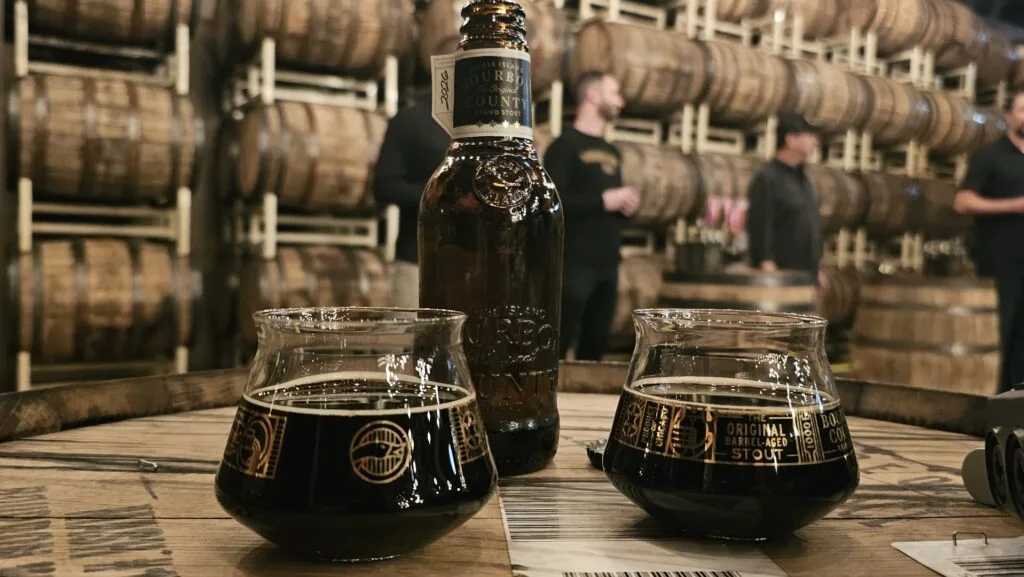
2026 Bourbon County Brand Original Stout
How they described it: Todd kicked things off: “This is our base beer. This is the first one… always my favorite, still my favorite.” Original is always the base beer for multiple variants, including this year’s Apple Crisp and Tiramisu. It’s a blend of barrels from Buffalo Trace, Heaven Hill, Wild Turkey and Four Roses, chosen on purpose so each distillery’s mash bill, barrel age and spirit can add something different, and this vintage averaged about 13 months in the wood. Six full-time brewers in the barrel house taste it every month as it ages and blend it toward the Original flavor profile, but every year’s weather and barrels nudge it a little differently. The team listed cocoa, chocolate, vanilla, warming spice, and the nutty almond, marzipan and dried fruit notes that come from slow oxidation in the barrel. Fun detail: Daryl was the first to call out molasses in this year’s batch, and once he said it, the others started picking it up too.
What we thought: This honestly might be my favorite Original of the last five, six, maybe seven years (with apologies to the 2024 release, which was another banger). My reaction was immediate, and not a given. I remember one other year, I took my first sip of Original and thought to myself “oh, no,” because it didn’t hit for me. This was not that. The flavor that jumped out at me this year was dark chocolate. Not milk chocolate, and not bitter exactly, but that rich, deep, serious dark chocolate you get from the kind of bar that prints a percentage on the wrapper. You can taste all the other layers too, but that chocolate is what made it such a nice beverage.
And here’s the temperature payoff I promised: it was served at the PERFECT temperature. It was warm enough to open up, but not so warm that it got hot. If I’d pulled this straight out of my regular refrigerator, I honestly might not have loved it this much. At the right temperature, it was basically a flawless stout. I will be buying a lot of this one.
ABV: 14.2% (per Goose Island, a little lower than last year)
Barrel tally: 1. (Yes, it’s four distilleries, but they’re all bourbon barrels, and Goose counts barrel types, not distilleries. They’re the experts.)
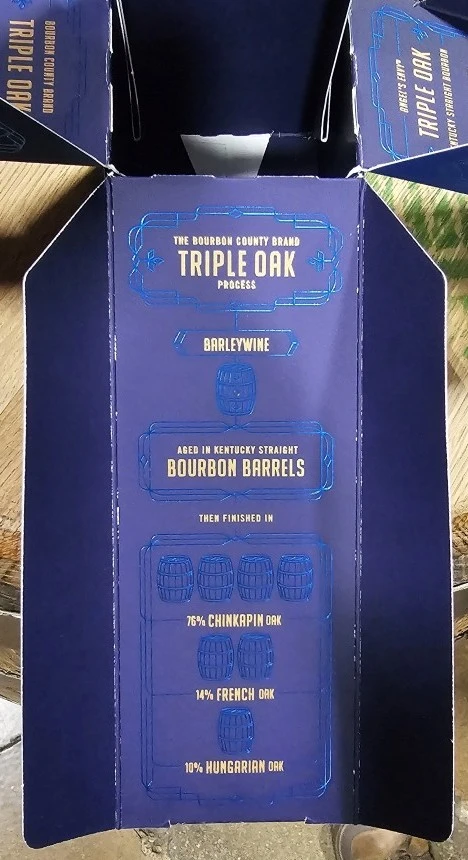
2026 Bourbon County Brand Triple Oak Barleywine
How they described it: This one is a collaboration with Angel’s Envy, and it’s been in the works since 2023, when Goose last partnered with the distillery on a cask finish stout. John and Daryl got to taste Angel’s Envy’s Triple Oak whiskey before it was ever released to the public, while master distiller Owen Martin was still finalizing it. That whiskey starts as Kentucky straight bourbon and then gets finished in French oak, chinkapin and Hungarian oak, and the Goose team was blown away by the layers of vanilla, spice, caramel and tannin. So naturally, they wanted the barrels.
They trialed the barrels with both a stout and a barleywine. The stout worked, but its roast covered up some of the subtler things each oak was bringing. The barleywine’s natural sweetness and dried fruit character softened the tannin and let the oak actually shine. The finishing blend is 76% chinkapin, 14% French oak and 10% Hungarian. They leaned hardest on chinkapin because French oak turned out to be shockingly expressive (think of how polarizing an oaky Chardonnay can be). And don’t worry if you’re not taking notes, because the box folds out into three panels that show you that whole breakdown.
John was refreshingly honest about his own barleywine habits: “I am a self-admitted person where I’m like, I don’t reach for a barleywine all the time. This one, however, I absolutely love.” He explained that barrel-aged barleywines can get too sweet for him, but that second barrel type and its tannin cut the sweetness and add structure: “I think by actually finishing this in a second barrel type, it just really balanced all that out. And I think this is, for me, like, this is the exact type of barleywine that I would want to drink.” Daryl put it simply: “sweet with bitter is one way to balance, sweet with tannin is another way to balance.”
What we thought: For some context, I am a huge barleywine guy, especially when it comes to Goose Island’s barleywines. One of my favorite BCBS variants of all time was their 2015 Barleywine (yes, the infamous infected year; I either got lucky or have questionable taste), and I’m infamously on record as literally shouting in excitement about King Henry II when they pulled it out at last year’s event. This barleywine did not disappoint, but it has a very different character than their previous takes on barleywine. I usually like my barleywines on the sweeter side, and this is not that. It’s drier and more reserved than its sweeter counterparts, with a really clean, crisp finish. It’s also a very strong beer, so respect it accordingly.
If you’re expecting a sweet, sugary, syrupy barleywine, this isn’t going to scratch that itch. But if you want a barleywine that lets the wood do the talking without going heavy on the sweetness, then this is a great one. I am definitely going to pick up a bottle because I feel like it has a complexity and depth that I could really sit with for a while. The small pour I had was tasty, but I could tell I would have gotten a lot of enjoyment from being able to fully process it as I drank it. Worth checking out for sure.
ABV: 16.2% (per Goose Island)
Barrel tally: 4. (Bourbon, plus three new species of oak. We’re cooking now.)
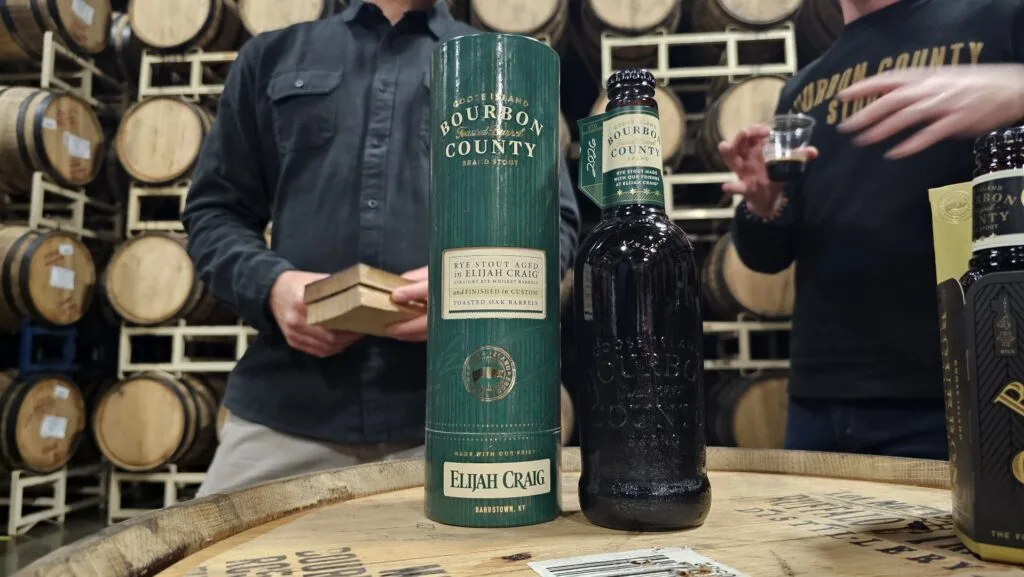
2026 Bourbon County Brand Toasted Barrel Rye Stout
How they described it: This is a rye stout that follows the same path Heaven Hill takes with Elijah Craig Toasted Rye whiskey: it starts in rye whiskey barrels, then gets finished in custom toasted oak barrels. The base beer uses three kinds of rye (caramel rye, heavily roasted rye and malted rye), and it comes out of the brewhouse a little sweeter than Original, which matters because rye brings a lot of tannin and so does every extra barrel. (If tannin is a fuzzy concept for you, John described it as that drying feeling you get from grape skin or apple skin. It’s not really a taste so much as a structure.)
The toast is the star here, and John passed around two pieces of wood to show us why. A standard bourbon barrel gets charred hard and fast, which gives you that crackly “alligator char” on the surface but doesn’t go very deep. A toasted barrel is cooked lower and slower, so the sugars in the oak caramelize much deeper into the wood, and the spirit (and then the beer) pulls all of that back out. John said it gives the beer an intense, almost smoky quality and a kind of bramble character: “I don’t think we’ve had a BCS quite at this characteristic, and it’s incredible.” He calls it crème brûlée. Daryl, a dad of two, calls it something else: his kids want s’mores every time they build a backyard fire, and “they love to burn their marshmallows to a crisp.” Burnt marshmallow, burnt sugar, toasty campfire. You’ll see.
What we thought: I’ll be honest: I did a very poor job of writing down exactly what notes jumped out to me with this beer. Instead, all I can really say is that this one is just as good as the Original, but tastes totally different, with different notes and flavors. Comparing the two is apples and oranges (I’ll get to actual apples shortly). The one thing I do clearly remember is the toasted character; that caramelized, burnt-sugar, toasty thing is unmistakable and I really, really liked it.
I wasn’t sure if I’d enjoy the rye because I’ve not had the best experience with rye stouts in the past, but this one didn’t have much rye bite at all and it didn’t seem bitter to me in the slightest. It’s honestly wild how much a different barrel can radically change the flavor of a beer. This is the theme of the year working exactly as advertised.
ABV: 16.2% (per Goose Island)
Barrel tally: 6. (Rye whiskey barrels and custom toasted oak. Two more!)
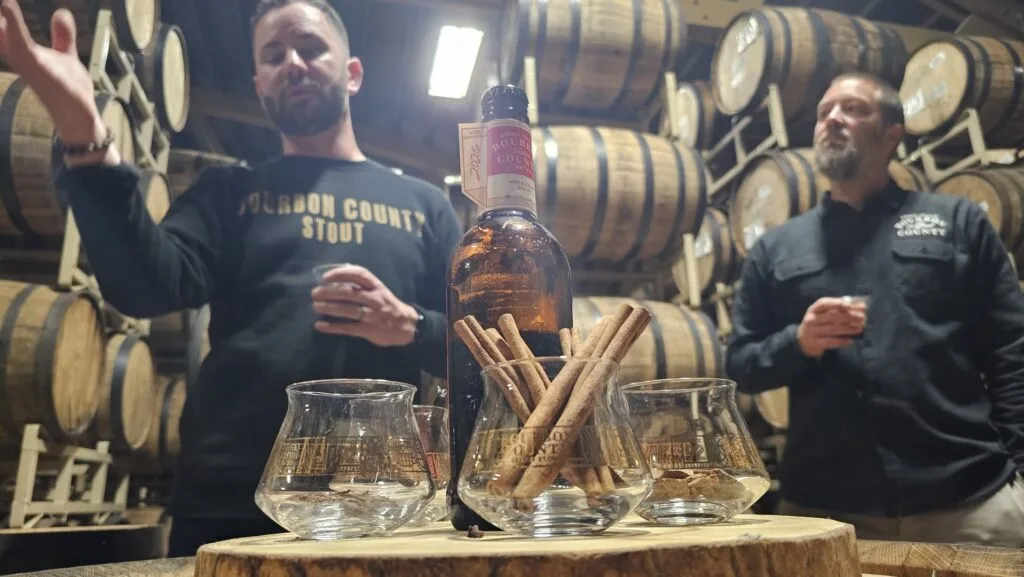
2026 Bourbon County Brand Apple Crisp Stout
How they described it: Every year, any Goose Island employee, whether they work in sales, HR, e-commerce, marketing or brewing, can take Original and submit a variant concept. The team tastes them completely blind across three rounds, sometimes with upwards of 40 submissions, and everyone writes feedback. Past submissions have included things like macaroon and fig cookie. (Someone in our group pitched mac and cheese and General Tso’s chicken; fortunately or unfortunately, those haven’t come up yet. I would still like to formally request a tasting of the General Tso’s.)
This year’s Apple Crisp came from barrel team member Chase Craig, who also created this year’s Proprietor’s. John admitted he was skeptical when he first saw it, but said those end up being some of the best variants, because the ones your brain can’t imagine working are the ones that blow your mind. This was one of them; it “really just worked on a level that I would have never thought to try and make an apple crisp.”
The spices are nutmeg, clove, and two kinds of cinnamon (Saigon and cassia), chosen because they echo the spice notes the barrel already gives the beer. Apple puree lifts and brightens everything, and panela sugar mimics the molasses-y, caramelized, crispy top of the dessert. Fun fact from Daryl about why they’re so careful with dosing: “cinnamon does not go away, like in 20 years the cinnamon level will be the same in this beer as it is right now.” Other flavors fade as a beer ages; cinnamon is forever. John, who used to work in restaurants, said it just made him feel cozy: “it just reminded me of my grandparents.”
And here’s the big news: for the first time ever, Goose Island entered a Bourbon County variant in the Great American Beer Festival before releasing it, and Apple Crisp won bronze in the Dessert or Pastry Beer category. Last year’s Baklava Proprietor’s took gold in the same category, so Goose walked away with two of the three medals. (Goose also won Brewery and Brewer of the Year in the Over 100,000 Barrels category. Not a bad year!)
What we thought: Everyone in the room freaked out about this beer. People were losing their minds, insisting it’s one of the best stouts Goose has ever made. One attendee asked if they’d ever bring it back (their response was non-committal in either direction), and the general consensus was that you could put this on the Thanksgiving table and everyone there would enjoy it, whether they like dessert or not, and whether they like beer or not.
I loved it. On the nose, I actually got more cinnamon than apple, and the whole thing just tastes like a perfectly balanced apple crisp. It was so good that it distracted everyone from the next beer (the Tiramisu) because people kept talking about it and asking questions about why they can’t buy it year-round. That also partially excuses why my terrible photo below of the Tiramisu is grainy and sloppy-looking; things were a bit chaotic with all the apple crisp stout chatter while John and Daryl were trying to move on to the next beer.
Apple Crisp was the beer everyone was still talking about after the tasting. Put it on your list. Put it at the top of your list.
ABV: 13.9% (per Goose Island)
Barrel tally: still 6. (Apple Crisp is aged in bourbon barrels, so the barrel’s contribution here is the spice, not a new barrel type. Hang in there.)
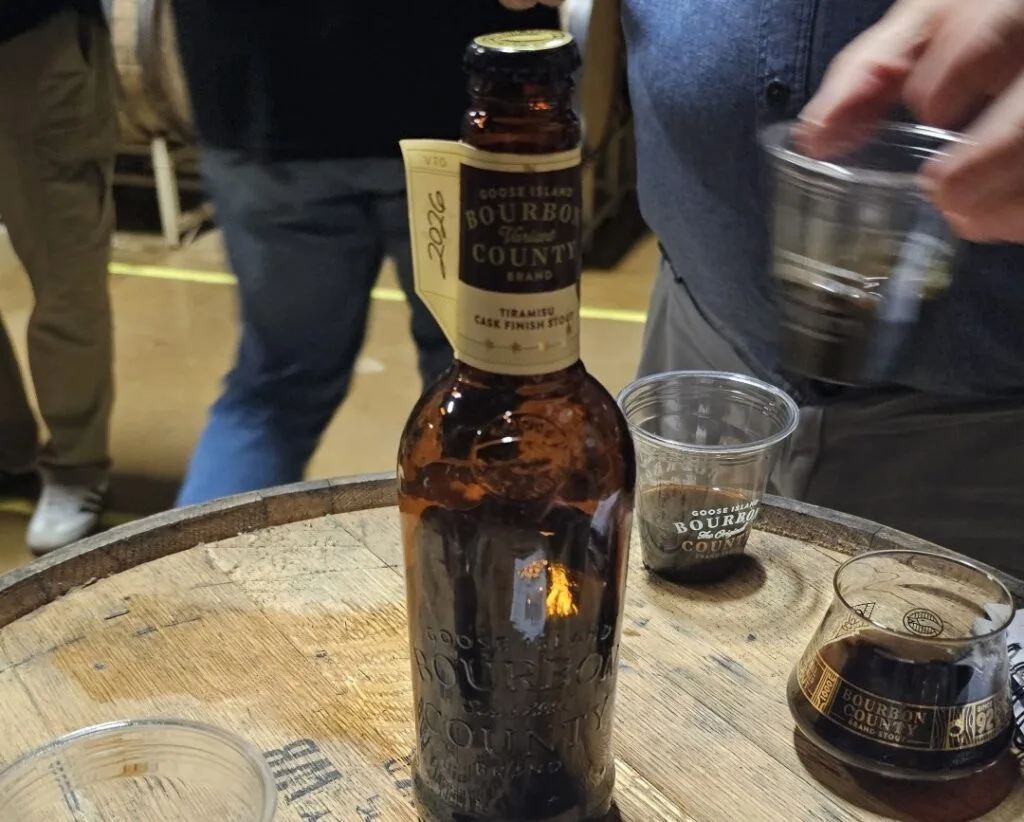
2026 Bourbon County Brand Tiramisu Cask Finish Stout
How they described it: This is Original, aged in bourbon barrels and then finished in rum casks with espresso, cocoa nibs and vanilla, and it’s the first time Goose Island has ever finished a Bourbon County stout in rum barrels. Actually, make that two kinds of rum barrels: an American rum, for a forward, straightforward spirit character, and a Caribbean rum, which brings more molasses, cane sugar and a little bit of funk.
Why two? Daryl explained that rum casks from that part of the world get reused over and over again, which builds up a really unique funky character in the wood. Domestic rum barrels are typically used once, maybe twice, so they give you more of a straight distillate character: still sweet, but a totally different animal. In this beer, the two balance each other out.
The concept came from brewer Mike Owens, who was inspired by one specific part of the dessert: “Think of like the little squishy layer in the middle of a tiramisu.” The team encouraged us to sip back and forth between this and Original to see how the coffee amplifies the chocolate and roast, and how the vanilla brings up notes that were already in the base beer without covering it up.
What we thought: This actually might have been my favorite variant of the lineup (it’s neck and neck with the Original, and I reserve the right to change my mind after a second third bottle). There’s this deep, deep espresso flavor that I’ve never experienced in a beer before. It filled my whole mouth, all the way to the back of my palate. I don’t want to say it was “smoky,” because that’s not quite it, but it’s vivid, rich, thorough espresso in a way that’s hard to describe — and very easy to drink.
But the thing is, this is decidedly not a coffee or an espresso stout. It’s very distinct from past stouts they’ve done like the 2019 Café de Olla. It was fantastic, and my only regret is that I didn’t get to spend more time with it before we moved to the next station. I will be buying a couple bottles of this one.
ABV: 15.1% (per Goose Island)
Barrel tally: 8! (American rum and Caribbean rum. We did it! Eight. I can count. Also, yes, Goose Island’s original press release said there were 7 barrel types, but John counted American and Caribbean rum separately, and so am I, since they’re used and reused so differently.)
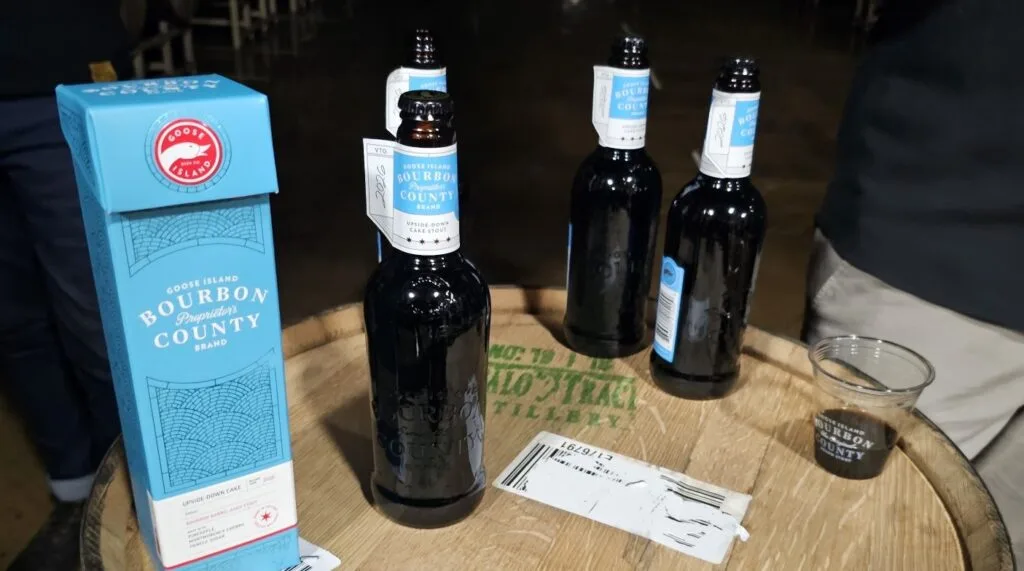
2026 Bourbon County Brand Proprietor’s Stout (Pineapple Upside-Down Cake)
How they described it: Proprietor’s is the Chicago-only variant, and John described it as the most adventurous member of the Bourbon County family: Goose Island’s love letter to the city that embraced a weird, bourbon barrel-aged stout back in 1992, when most people were still drinking light lagers. This year’s concept also came from Chase Craig, making him two for two in this lineup. (“He likes fruit,” someone joked.)
This dessert is personal for John: “my grandma would always cook this cake at least once a week for us.” He admitted he was a little skeptical about it as a barrel-aged stout, but the concept clicked once he thought about what the barrel already brings. The caramelized sugars from the oak play the role of the cake’s crunchy, caramelized top. Montmorency cherries add the cherry and a little baking spice, panela sugar rounds it out, and pineapple adds some lift, so the beer is cozy but also kind of refreshing. In John’s words, it’s “very quintessential, very Midwest.”
Daryl pointed out that there’s a fair amount of acidity in this beer, which is doing important work. Between the cherries, the pineapple, the caramelization and Bourbon County itself, there’s a lot of sweetness happening, and as Daryl put it, “acidity is another way to balance the sweetness.” One more note: Proprietor’s wasn’t ready in time to enter GABF this year, so Apple Crisp had to carry the medal hopes for this lineup on its own. (It did fine.)
What we thought: For me, the pineapple really hit. The Montmorency cherry and panela sugar are in there too, and the whole thing works as a really nice dessert beer. It’s not overly sweet in any way; they struck a really good balance. If you didn’t love how sweet the Caramella Wheatwine was a few years ago, don’t worry, this isn’t in that category. It’s more reserved, but still definitely pineapple-y.
In the interest of full transparency, by this point in the tasting I had consumed at least 10 ounces of Bourbon County across six beers, every one of them well over 10% ABV, so my palate wasn’t as sensitive as it was at the start. I’d love to revisit this one with fresh taste buds. I know I liked it, but how MUCH did I like it? I’m gonna need another bottle or two (or three) to fact check myself.
ABV: Not yet announced (per Goose Island)
Barrel tally: 8, holding steady. (Bourbon barrels only. The pineapple does not count as a barrel, no matter how much I want it to.)
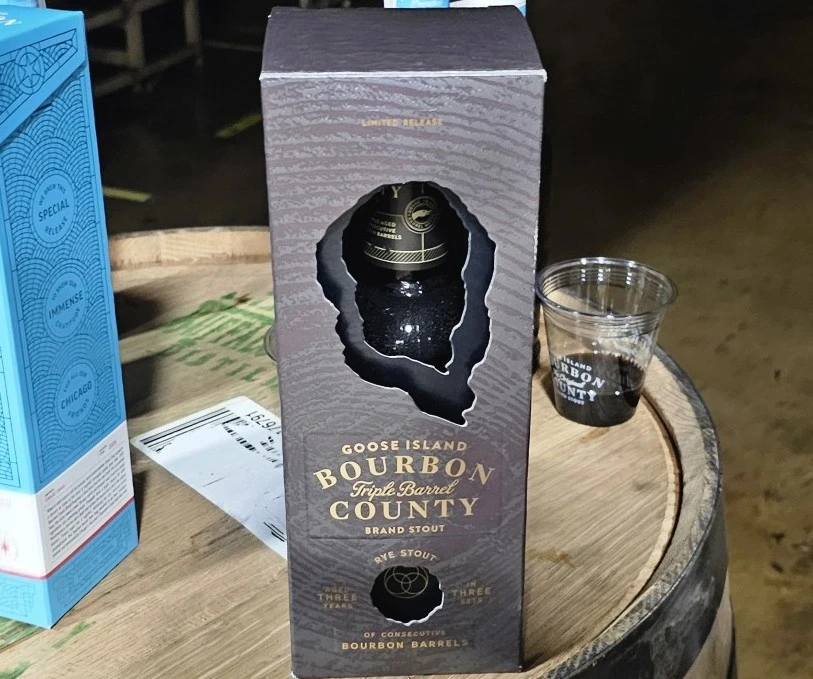
2026 Bourbon County Brand Triple Barrel Stout
How they described it: If you were worried the barrel theme was too subtle, John put that to rest: “this is the first time that we’ve ever released a triple barrel stout.” Not one, not two, but three barrels, one after another. They took the rye stout and aged it in King of Kentucky bourbon barrels, then moved it to Birthday Bourbon barrels, then finished it in a blend of Old Forester and King of Kentucky barrels, for a total of three years in the wood.
Every barrel adds more tannin, more structure and more alcohol, which is why they went with the slightly sweeter rye stout as the base instead of Original. The result is 18.7% ABV, with more oxidation, a lot more spirit, and what John called “this very fudgy, brownie-like characteristic to it that is just incredible.”
This is the most exclusive variant, and will only be available at Goose Island’s Salt Shed pub and Fulton Street taproom (and at Prop Day). If you see someone selling a “full lineup” online, this one won’t be in it. The scarcity is due to the fact that they lose a lot to evaporation over three years, not because they thought it would be fun to just arbitrarily make less of it.
What we thought: If you love bourbon, then you will love this beer. If you don’t, then… you might not? I thought this was the most polarizing beer of the night. Some people said it was far and away their favorite, and every one of those people, as far as I could tell, loves bourbon. You are going to get a LOT of bourbon character from it.
The word I’d use to describe it is “dense.” Not heavy, and not exactly thick, but dense. It’s not fudgy in terms of flavor, but in terms of consistency, John’s fudge comparison is perfect. When you think about how fudge compares to a regular piece of chocolate, you think it’s richer, it’s more concentrated, and it’s not something you’re going to want to scarf down. This beer is that.
I mentioned to the group I thought it might be a little much for some people, because it has a real bite to it. Daryl’s response was that if you like bourbon, it’s amazing, and that’s kind of the point of having a lineup this varied: some beers are sweeter and fruitier and appeal to a wider crowd, and then you’ve got one like this, which goes deep into the weeds on alcohol. As he put it: “that is just boozy and like so much depth to it.” He’s not wrong. If you’re here for the bourbon, this is for you. If you’re not, it probably won’t be. For me, a casual BCBS drinker, it was “too much.” I could tell it is not a bad stout, but boy, you’d better buckle up, because it’s a lot to handle. The ABV alone tells part of the story.
ABV: 18.7% (per Goose Island)
Barrel tally: technically still 8, because three bourbon barrels are still bourbon barrels. I’m retiring the tally here before Goose Island finds a ninth one and makes me start over.
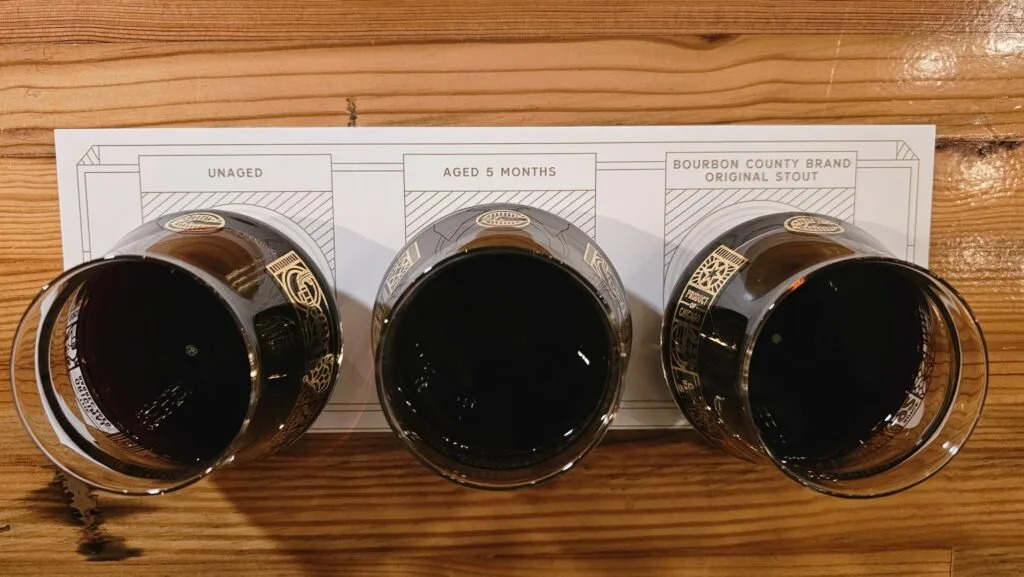
Bonus pour: Bourbon County, before it was Bourbon County
To close things out, Goose Island showed us where it all starts: they served us Bourbon County unaged, fresh off the tank before it ever touches a barrel, followed by a sample aged just five months.
Daryl explained what we were in for: fermenting a beer up to almost 12% alcohol is rough on yeast, and stressed yeast throws off banana-like esters. The roast is super high, and there’s a lot of hop bitterness that helps protect the beer while it ages. Someone at the table summed it up as “lots of tobacco.”
The guy sitting across from me reacted like he was physically gagging. I, personally, found it intolerable. Daryl’s take: “it’s not horrible, but it’s not made to be consumed fresh.” With all due respect to Daryl, who knows more about this beer than I ever will, I’m going to have to respectfully disagree on the “it’s not horrible” part. But he’s 100% right about the fact that it’s not made to be consumed fresh, and that’s the point! This isn’t a shot at Goose Island in any way. It was never meant to be consumed fresh, and that’s exactly what makes it so fascinating.
Think about it: Greg Hall brewed a big, roasty, frankly “mid” beer that’s not great on its own at all, and it somehow magically becomes Bourbon County after it spends time in a bourbon barrel. This wasn’t a THING people were doing regularly at the time. So like… how did he know?! How can you possibly say “if I brew this basically crappy beer but then age it in bourbon barrels, it will blossom from a caterpillar into a butterfly” with a straight face and have it actually work?!
Daryl’s answer was that it took “a little bit of intuition and a little bit of luck.” Greg knew he needed a beer expressive enough to stand up to bourbon, because “you can’t put a pilsner in a bourbon barrel and expect that to come out well.” Brian, who hosts Crafty Brewers, always says on our show that brewers are like mad scientists (in a good way). The story of this beer feels like strong evidence that he’s right.
The five-month sample didn’t taste great either, but you can tell it was approaching something more palatable. The harsh edges were rounding off, the banana was fading into the background, and the chocolate was starting to come forward. You could actually see it turning into Bourbon County. The brewers also made a point I hadn’t fully appreciated before: the warehouse isn’t temperature controlled on purpose, so the Chicago summers and winters push the beer in and out of the wood, and Goose is only a five-hour drive from Louisville, so the barrels arrive fresh and still wet with bourbon. As John put it, “this is a very uniquely Chicago product.”
TL;DR
In case you skipped to this section instead of reading my extremely long essay (no judgment, I’d do the same), here’s what to expect from this year’s BCBS lineup:
- Original: Possibly my favorite Original in years. Rich, deep dark chocolate, and flawless at the right temperature. I’m buying a lot of it.
- Triple Oak Barleywine: Drier and more reserved than sweeter barleywines, with a clean, crisp finish. Not for the syrupy-barleywine crowd, but a great example of letting the oak do the talking.
- Toasted Barrel Rye: Bizarro Original. Totally different flavors, equally good. The toasted, burnt-sugar character is the star, and the rye doesn’t bite.
- Apple Crisp: The showstopper. Everyone lost their minds, it took bronze at GABF, and it belongs on your Thanksgiving table. Lots of cinnamon on the nose.
- Tiramisu: Possibly my favorite variant. A deep, vivid espresso flavor that fills your whole palate. Don’t sleep on it.
- Proprietor’s (Pineapple Upside-Down Cake): The pineapple hits, and it’s a well-balanced dessert beer that never gets too sweet. Chicago only.
- Triple Barrel: Dense, boozy, 18.7% and extremely bourbon-forward. Bourbon lovers will adore it; everyone else, proceed with caution. Available at the Goose Island taproom, pub, and Prop Day only.
What I loved most about this year’s lineup is that the variants don’t just tiptoe a few steps away from Original. They launch themselves in completely different directions, so if you love one, you might not love another, and that’s kind of the point. Pick the direction that sounds like you.
Thank you once again to Goose Island for inviting Crafty Brewers: Tales Behind Craft Beer to check out this year’s Bourbon County Brand Stout lineup. Now go check out one of our podcast episodes. I promise, they have fewer barrels than this post. Cheers!